
Consumer confidence fell in November – the confidence indicator dropped to −11.2
The consumer confidence indicator fell to −11.2 in November, for the third month running. 42 per cent of consumers plan to cut back on purchases of durable goods, and 51 per cent expect unemployment to rise.
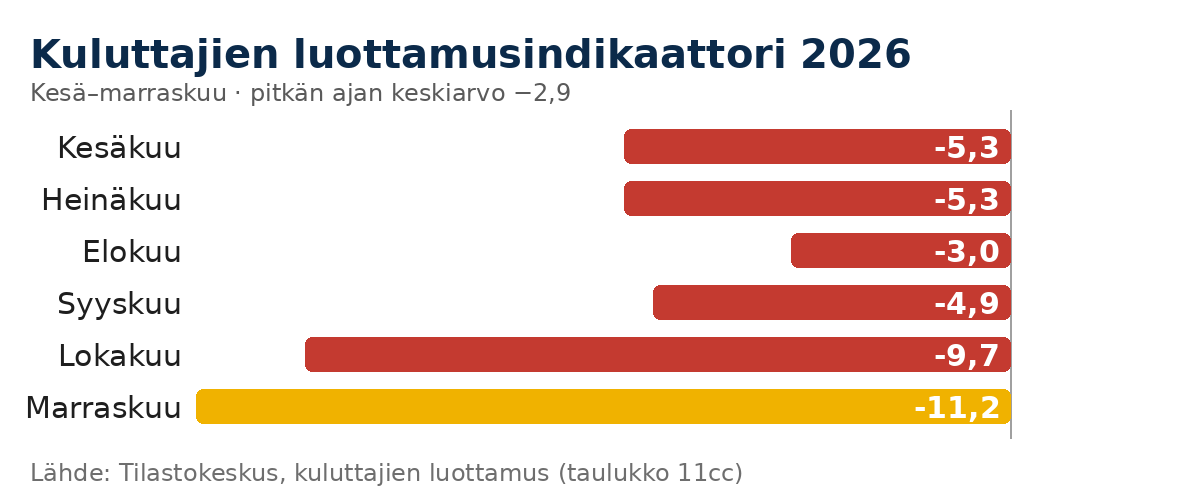
Finnish consumers’ confidence in the economy fell in November 2026 for the third month running. According to Statistics Finland, the consumer confidence indicator fell from −9.7 in October to −11.2 in November. In particular, assessments of one’s own current financial situation and intentions to make major purchases were weak.
The results reflect households’ views on the economy, employment and future spending. This is a survey measuring consumer expectations, and the results do not require households to take any action.
Key figures
- −11.2: Consumer confidence indicator in November 2026.
- −1.5 index points: Change from the previous month.
- −4.7 index points: Change from a year ago.
- −2.9: Long-term average of the confidence indicator.
Consumer confidence fell for the third month running
Consumer confidence has weakened for three consecutive months since August. The November reading was 8.3 index points below the long-term average.
In November 2025, the confidence indicator stood at −6.5.
Trends in the consumer confidence indicator in 2026:
| Month | Confidence indicator |
|---|---|
| June | −5.3 |
| July | −5.3 |
| August | −3.0 |
| September | −4.9 |
| October | −9.7 |
| November | −11.2 |
Concerns about personal financial situation and major purchases
November’s weak confidence reading highlighted consumers’ assessments of their current financial situation and their limited intentions to purchase durable goods.
Thirty-one per cent of consumers assessed their personal financial situation as being weaker than a year ago. Twenty per cent assessed their situation as being better.
Sixty per cent of consumers rated Finland’s economic situation as weaker than a year ago, whilst 12 per cent rated it as stronger.
However, expectations regarding the future of their own finances were more positive than those for the Finnish economy. Over the next 12 months, 27 per cent of consumers believed their personal financial situation would improve, whilst 22 per cent expected it to deteriorate.
Twenty-three per cent of respondents expected the Finnish economy to improve, whilst 39 per cent expected it to deteriorate.
Consumers are cautious about making major purchases
Only 13 per cent of consumers considered November to be a favourable time to purchase durable goods.
Over the next 12 months, 9 per cent of consumers planned to spend more on durable goods than before. 42 per cent planned to spend less.
Consumers’ purchasing intentions over the next 12 months:
- Car purchase: 12 per cent.
- Buying a home: 11 per cent.
- Home renovation: 15 per cent.
These figures reflect consumers’ plans and purchasing intentions, not actual purchases or consumer spending.
More than half of consumers expect unemployment to rise
The employment outlook was bleak in November. Fifty-one per cent of consumers expected the number of unemployed people to rise over the next 12 months. Nineteen per cent believed the number of unemployed would fall.
Of those in work, 32 per cent felt that the threat of personal unemployment or redundancy had increased. Six per cent felt that the threat had decreased.
Of those in work, 32 per cent did not feel any threat of unemployment or redundancy at all.
Consumers expect prices to continue rising
Consumers estimated that prices had risen by an average of 5.0 per cent over the previous 12 months.
Over the next 12 months, consumers expected prices to rise by 4.4 per cent.
These are consumers’ own estimates and expectations regarding price trends, not official inflation figures.
Saving is more appealing than borrowing
In November, 38 per cent of consumers considered saving to be worthwhile. Twenty per cent considered borrowing to be a good idea.
Over the next 12 months, 16 per cent of consumers planned to take out a loan.
Fifty-six per cent of consumers had managed to save money. Sixty-eight per cent believed they would be able to save over the next 12 months.
There are significant regional differences in confidence
Consumer confidence was strongest in the Helsinki metropolitan area in November, where the confidence indicator stood at −6.9. Confidence was weakest in Eastern Finland, where the figure was −16.3.
There were also significant differences between different population groups.
| Demographic group | Confidence indicator |
|---|---|
| Senior white-collar workers | −1.2 |
| Unemployed | −22.2 |
| Pensioners | −19.8 |
| Women | −13.7 |
| Men | −8.8 |
Confidence among senior white-collar workers was clearly stronger than among the unemployed and pensioners. Men’s confidence was stronger than women’s.
How is the consumer confidence indicator calculated?
Statistics Finland’s consumer confidence indicator is based on the average of four balance figures.
| Component of the indicator | November 2026 |
|---|---|
| My current financial situation | −8.2 |
| My financial situation in 12 months’ time | +3.1 |
| The Finnish economy in 12 months’ time | −13.5 |
| Plans for spending on durable goods | −26.2 |
| Consumer confidence indicator | −11.2 |
Balance figures can vary between −100 and +100. A negative figure indicates a predominance of negative assessments, whilst a positive figure indicates a predominance of positive assessments.
1,148 people responded to the November survey. The response rate was 53 per cent, and responses were collected between 1 and 18 November 2026.
What does this mean for you?
Weak consumer confidence is particularly evident in the caution shown when planning major purchases. When households feel uncertain about their own finances and employment prospects, they may, for example, postpone buying a car, purchasing a home or carrying out home improvements.
If this cautious attitude towards spending is also reflected in actual spending patterns, it may signal subdued growth in household consumption. This, in turn, may be reflected in business demand and employment.
However, the confidence indicator does not predict the financial situation of an individual household or job security. It reflects consumers’ general economic confidence and expectations for the future.
The November result does not, in itself, require you to take any action.
Read also


Read next in the same section
Explosion next to a school in Afghanistan – 7 students killed, nearly 100 injuredReport an error · Discuss on Facebook @arkisuomi
Publisher: Arki Suomi · About us and the newsroom · Contact