
Generative AI is becoming more widespread in Finland – 58 per cent of the population already use it
As many as 58 per cent of people aged 16–89 had used generative AI by 2026, compared with 41 per cent the previous year. Its use is most common during leisure time and amongst young people: 85 per cent of 16–24-year-olds are already users.

According to Statistics Finland, 58 per cent of people aged 16–89 living in Finland had used generative artificial intelligence in the previous three months in 2026. In 2025, the corresponding figure was 41 per cent. AI is most commonly used during leisure time. These are statistics describing the population’s use of technology, which do not require any action on the part of the reader.
Key figures
- 58 per cent had used generative AI in 2026.
- 41 per cent had used generative AI in 2025.
- 42 per cent used generative AI in their free time or for purposes other than work or study.
- 71 per cent had come across information online that they considered to be false or whose veracity they were unable to assess.
The use of generative AI grew by 17 percentage points in one year
The proportion of people aged 16–89 using generative AI rose from 41 per cent in 2025 to 58 per cent in 2026. This represented an increase of 17 percentage points.
For the purposes of these statistics, even a single instance of use within the last three months is counted as use of generative AI. Use may take place via an app or a web browser.
What is AI used for? – Leisure time is the most common
Generative AI was most commonly used for leisure or for purposes other than work or study: 42 per cent of 16–89-year-olds. It was used for work or professional purposes by 30 per cent and for degree-level study by 14 per cent.
Respondents could select multiple purposes, so the percentages do not add up to 100 per cent.
Differences between age groups
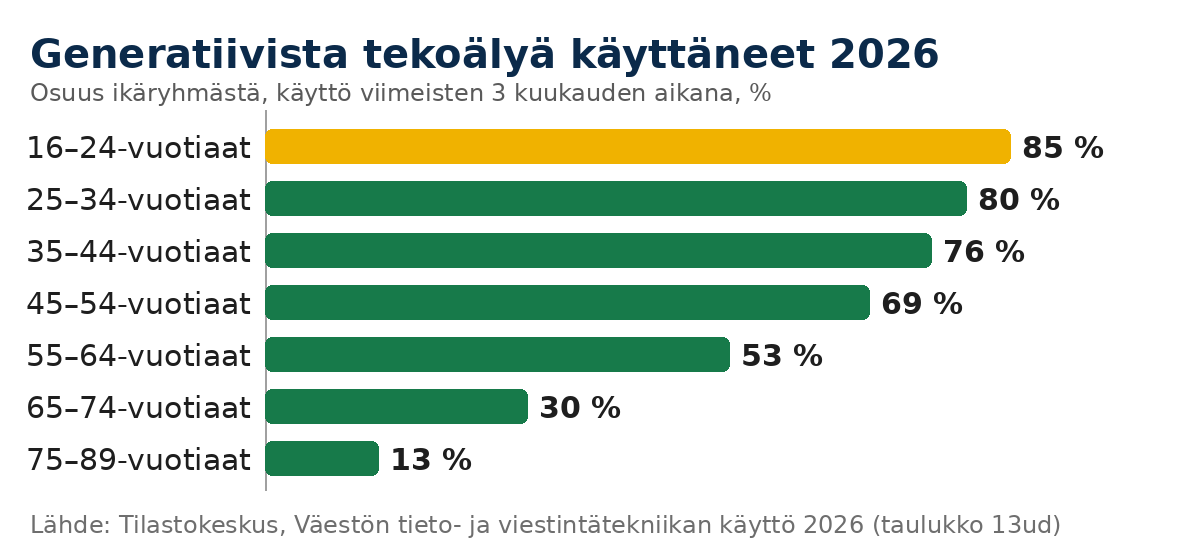
The use of generative AI is most common among the youngest age groups and least common among the oldest. Usage decreases with age in every age group.
| Age group | Percentage of users |
|---|---|
| 16–24 | 85 |
| 25–34 | 80 |
| 35–44 | 76 |
| 45–54 | 69 |
| 55–64 | 53 |
| 65–74 | 30 |
| 75–89 | 13 |
Use for study purposes is particularly prevalent among young people: 53 per cent of 16–24-year-olds used generative AI for study, 24 per cent for work and 49 per cent for leisure.
Students and the employed
87 per cent of students had used generative AI in 2026. In 2025, the proportion was 80 per cent. The proportion of students using it for study purposes was 68 per cent.
Of those in employment, 72 per cent had used generative AI in 2026. In 2025, the figure was 53 per cent. The proportion of those in employment using it for work was 50 per cent.
The digital divide among older people: they’re familiar with the internet, but not with AI
Internet use is almost universal: 95 per cent of 16–89-year-olds use the internet.
71 per cent of those aged 75–89 use the internet, but only 13 per cent of them had used generative AI.
The gap between internet use and the use of generative AI in the oldest age group is 58 percentage points.
Misinformation and hate speech
Encountering misinformation has become more common. In 2026, 71 per cent had seen something on news websites or social media that they considered to be false or whose veracity they were unable to assess. In 2025, the figure was 64 per cent. Forty-three per cent had checked the accuracy of what they had seen.
Fifty-two per cent had seen hostile or derogatory messages targeting individuals or groups on social media or news websites. This refers to having seen such messages, not necessarily to the messages being directed at the respondent personally.
Smart homes
The use of smart home devices is still relatively limited. 15 per cent had used an internet-connected heating, lighting or similar home system.
In a separate question, 7 per cent had used an internet-connected alarm system. These figures cannot be added together as they are the results of different questions.
Online shopping and Yle Areena
63 per cent had ordered or made a purchase online in the last three months. 74 per cent had watched the public service broadcasters’ online services, such as Yle Areena.
Method
The survey covers people aged 16–89 who live permanently in Finland. Responses are collected online and by telephone.
What does this mean for you?
Generative AI is currently, above all, a leisure tool. It is most commonly used for leisure or for purposes other than work or study.
AI-generated responses may be incorrect. It is advisable to check important information against the original source.
You do not need to take any action based on these statistics.
Read also



Read next in the same section
Taiwan's ruling party strengthens position in local elections – opposition retains TaipeiReport an error · Discuss on Facebook @arkisuomi
Publisher: Arki Suomi · About us and the newsroom · Contact