
What did the UN’s 1947 Palestine partition vote actually decide?
TODAY IN WORLD HISTORY · 29 NOVEMBER
The United Nations General Assembly adopted one of its early proposals for the future of Palestine on 29 November 1947. Meeting in New York, it recommended dividing the territory into an Arab state and a Jewish state, with a separate international arrangement for Jerusalem.
Seventy-nine years later, an important distinction remains: the Assembly approved a plan for partition. It did not carry out the partition by voting for it. The proposed settlement, set out in Resolution 181 (II), was never implemented as intended.
Watch the English video on Facebook: https://www.facebook.com/reel/2228509817697544
Watch the English video on YouTube: https://youtube.com/shorts/8SPkKGG3YjE
What was in the resolution?
The two proposed states were to be independent but linked through an economic union. The resolution outlined their boundaries and provided for a different arrangement in Jerusalem and its surrounding area. Rather than belonging to either state, that area would be administered internationally under the authority of the UN.
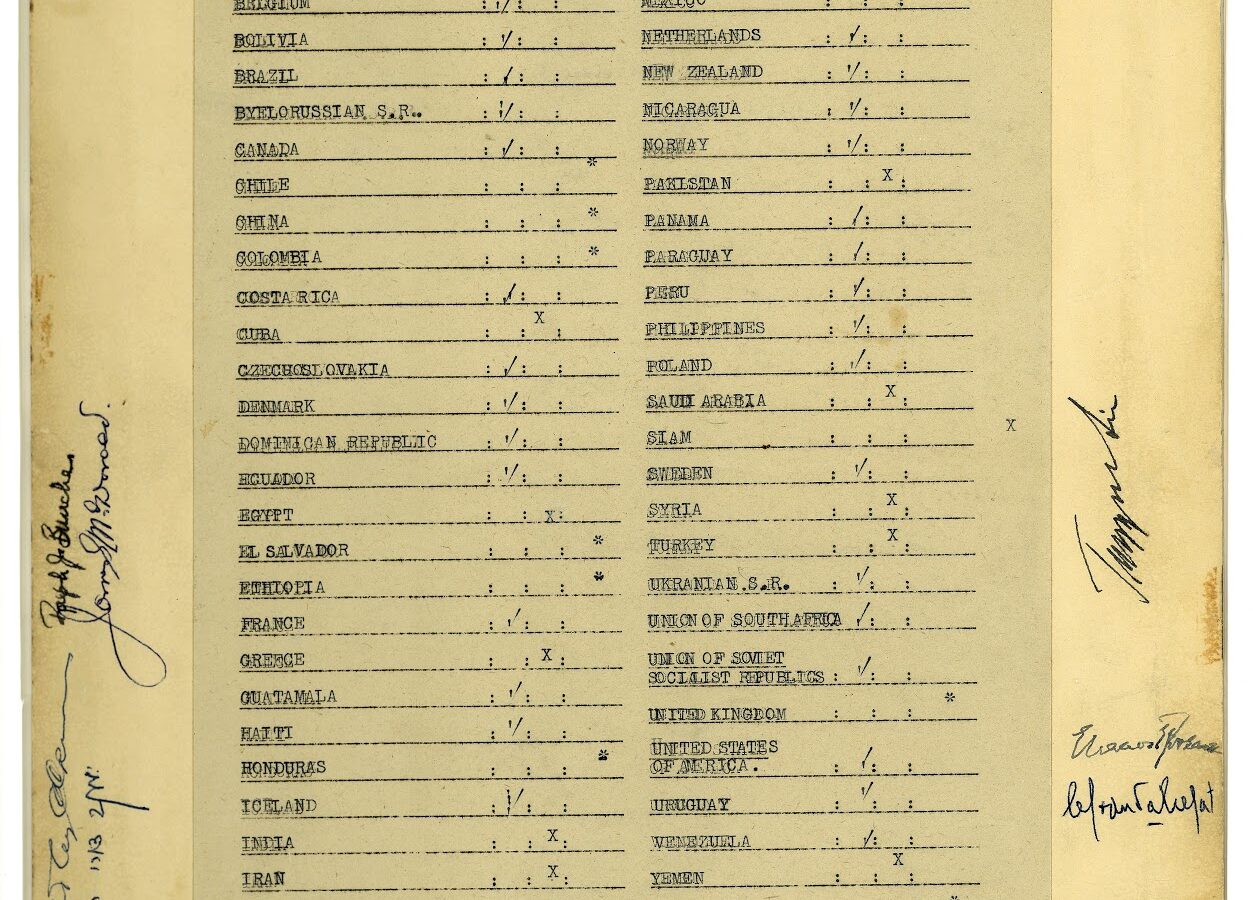
The proposal received 33 votes in favour and 13 against. Ten countries abstained and one did not vote, accounting for all 57 UN members at the time. The figures are preserved in the General Assembly’s official voting record.
These were votes by UN member states on a recommendation. They were not the result of a referendum among the inhabitants of Palestine.
Why was the United Nations involved?
Palestine was then administered by Britain under a mandate granted by the League of Nations. In 1947, Britain referred the question of Palestine’s future to the UN.
A special committee was formally established on 15 May under General Assembly Resolution 106 (S-1). Known as UNSCOP, it examined possible arrangements for the territory.
Its members did not all recommend the same solution. The committee’s report, submitted in September, contained a majority proposal for partition with economic union and a minority proposal for a federal state. The Assembly eventually adopted a revised version of the majority plan.
On 26 September 1947, Britain informed the UN that it would relinquish the mandate, as recorded in a subsequent British parliamentary debate.
How did the parties respond?
The Jewish Agency, a political representative body of Palestine’s Jewish community, accepted the partition plan despite reservations about aspects of the proposal.
The Arab Higher Committee, representing Palestinian Arab leadership, rejected partition, as did the Arab states. Among their objections was the argument that partition infringed the population’s right to self-determination.
A UN press release issued on 14 April 1948 records these opposing responses. The reservations and objections are also discussed in the UN’s historical account of the Palestine question. These were the positions of the organisations and governments concerned, rather than a record of every individual’s views.
The proposal and what followed
On 14 May 1948, the establishment of the State of Israel was proclaimed. A US National Archives document from that day records the United States’ recognition of the new state.
Britain’s mandate formally ended on 15 May, the date specified in the Palestine Act 1948.
The Arab state envisaged in Resolution 181 was not established under the plan, and its proposed international regime for Jerusalem did not materialise. The UN’s historical overview describes the subsequent developments.
Resolution 181 therefore records the settlement the General Assembly recommended in November 1947, not the territorial or political arrangements that ultimately emerged. Its proposed boundaries should not be read as a map of present-day borders.
Läs också
Teherankonferensen, 28 november 1943 – Där de tre stora kom överens om D-dagen
för 1 dag sedan
Svinhufvuds senat tillträdde den 27 november 1917 – nio dagar före självständigheten
för 2 dagar sedanLäs härnäst i samma avsnitt
The day before the Winter War: why the Soviet Union cut ties with Finland on 29 November 1939Rapportera ett fel · Diskutera på Facebook @arkisuomi
Utgivare: Arki Suomi · Om oss och redaktionen · Kontakt