
Consumer confidence in Finland falls to −11.2 in November 2026

Consumer confidence in Finland weakened for the third consecutive month in November 2026, with the consumer confidence indicator falling to −11.2 from −9.7 in October, according to Statistics Finland. Households remain concerned about employment, the national economy and their ability to make major purchases.
The results reflect consumers’ assessments and expectations rather than changes to household finances or government policies. No action is required from residents as a result of the figures.
Key figures
- −11.2: Finland’s consumer confidence indicator in November 2026.
- 8.3 points: How far confidence stands below its long-term average.
- 51%: Consumers expecting unemployment to increase.
- 42%: Consumers planning to spend less on durable goods over the next 12 months.
Consumer confidence declines for three consecutive months
After reaching −3.0 in August, consumer confidence deteriorated in September, October and November.
The November reading was 1.5 points lower than in October and 4.7 points lower than in November 2025, when the indicator stood at −6.5.
The long-term average is −2.9, placing the latest reading 8.3 points below that level.
| Month | Consumer confidence indicator |
|---|---|
| June 2026 | −5.3 |
| July 2026 | −5.3 |
| August 2026 | −3.0 |
| September 2026 | −4.9 |
| October 2026 | −9.7 |
| November 2026 | −11.2 |
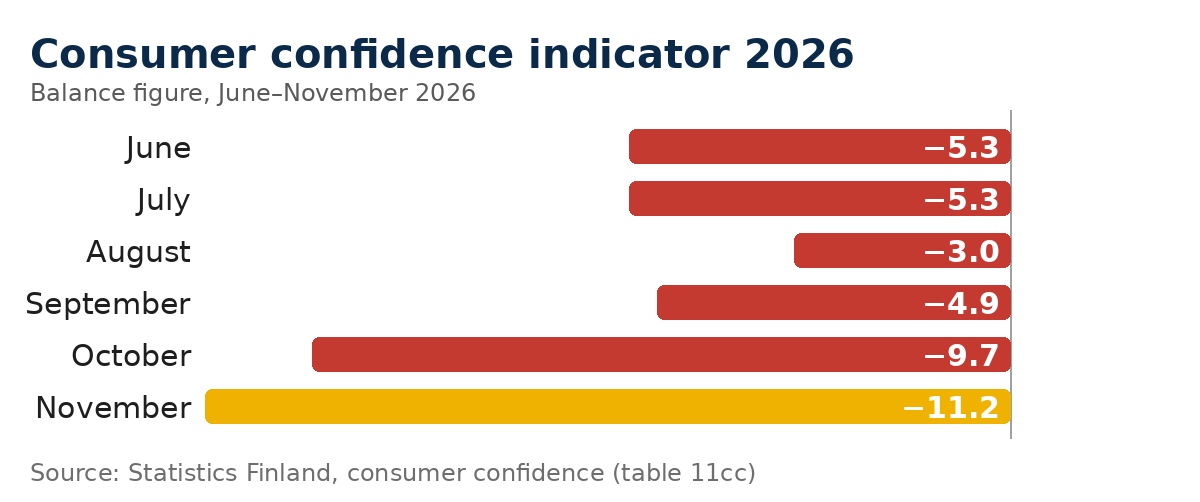
The figures show that consumer sentiment has become increasingly negative since August.
Households remain cautious about their finances and major purchases
In November, 31% of consumers described their own financial situation as worse than a year earlier, while 20% said it had improved.
Assessments of Finland’s economy were considerably more negative. Some 60% believed the national economy had weakened over the previous 12 months, compared with 12% who thought it had strengthened.
Consumers were somewhat more optimistic about their personal financial prospects than about the country’s economy.
Looking ahead over the next 12 months, 27% expected their own financial situation to improve and 22% expected it to deteriorate. Meanwhile, 23% anticipated an improvement in Finland’s economy and 39% expected a decline.
Reluctance to make expensive purchases was particularly evident. Only 13% of consumers considered the current economic situation favourable for major purchases.
Over the next 12 months, just 9% planned to spend more on durable goods, such as household appliances and furniture, while 42% intended to spend less.
Consumers’ purchase intentions included:
- Buying a car: 12%.
- Buying a dwelling: 11%.
- Carrying out home renovations: 15%.
These figures measure intentions rather than completed purchases.
More than half expect unemployment to increase
Employment prospects remain a major concern among consumers in Finland.
In November, 51% expected the number of unemployed people to increase over the next 12 months, while 19% anticipated a decrease.
Among respondents who were employed, 32% felt that their personal risk of unemployment or temporary lay-off had increased. Only 6% reported that the threat had diminished, while 32% considered themselves to face no such threat.
These findings reflect consumers’ expectations and perceptions of job security, not actual unemployment figures or forecasts of individual job losses.
Consumers expect prices to continue rising
Consumers estimated that prices had risen by 5.0% over the previous 12 months. They expected prices to increase by a further 4.4% over the following 12 months.
Both figures represent consumers’ own assessments of price developments. They are not Finland’s official inflation rate or an official inflation forecast.
Many households still expect to save money
Despite weak economic confidence, more than half of consumers reported having been able to put money aside.
In November, 38% considered saving worthwhile, while only 20% regarded the current situation as favourable for taking out a loan.
Some 16% planned to borrow money during the following 12 months.
Overall, 56% reported having been able to save, and 68% believed they would be able to save over the next 12 months.
The results indicate that negative economic sentiment does not necessarily mean households expect to lose their ability to save.
Confidence varies across regions and population groups
Consumer confidence was strongest in Greater Helsinki, where the indicator stood at −6.9. Eastern Finland recorded the weakest regional reading, at −16.3.
Significant differences were also visible between employment groups and between men and women.
| Region or population group | Consumer confidence indicator |
|---|---|
| Greater Helsinki | −6.9 |
| Eastern Finland | −16.3 |
| Upper-level salaried employees | −1.2 |
| Unemployed people | −22.2 |
| Pensioners | −19.8 |
| Women | −13.7 |
| Men | −8.8 |
Upper-level salaried employees were considerably less pessimistic than unemployed people and pensioners. However, all the reported regional and population-group readings remained negative.
How does Finland’s consumer confidence indicator work?
Statistics Finland’s consumer confidence indicator, commonly abbreviated as CCI, measures how consumers assess their financial circumstances, the wider economy and their future spending plans.
It is calculated as the equally weighted average of four survey-based balance figures.
| Indicator component | November 2026 |
|---|---|
| Own financial situation now | −8.2 |
| Own financial situation in 12 months | +3.1 |
| Finland’s economy in 12 months | −13.5 |
| Planned spending on durable goods | −26.2 |
Balance figures range from −100 to +100. A negative reading means pessimistic responses outweigh optimistic ones, while a positive reading indicates the opposite. Zero represents a balance between positive and negative responses.
The November indicator of −11.2 is therefore not a percentage or a measure of how much household income or economic output has declined.
Statistics Finland collected responses from 1,148 people between 1 and 18 November 2026. The survey response rate was 53%.
The figures are not seasonally adjusted.
What this means for you
For people living in Finland, including international residents, the November survey provides an insight into how households across the country are approaching spending, saving and employment.
When confidence is weak, cautious households may postpone buying cars, renovating their homes or making other expensive purchases. If this behaviour becomes widespread, it can contribute to weaker consumer spending and may have implications for businesses and employment.
However, consumer confidence is a measure of collective sentiment. It does not predict whether an individual will lose their job, experience financial difficulties or face higher living costs.
The November figures require no action from residents. They offer a snapshot of how consumers in Finland currently view their economic circumstances and the year ahead.
Читайте также

Generative AI in Finland: 58% of people now use it as adoption rises sharply
25 minuuttia
Родительское пособие в Финляндии: хронология от беременности до двух лет
2 часа назад
Ваше первое резюме в Финляндии: контрольный список для молодых соискателей без опыта работы
2 часа назадЧитайте далее в том же разделе
Generative AI in Finland: 58% of people now use it as adoption rises sharplyСообщить об ошибке · Обсуждение на Facebook @arkisuomi
Издатель: Arki Suomi · О нас и редакции · Контакты