
The Tehran Conference, 28 November 1943 – Where the Big Three Agreed on D-Day
On 28 November 1943, Roosevelt, Churchill and Stalin sat down together for the first time in Tehran. Over four days the Allies settled the plan that would open the second front: an invasion of northern France in May 1944, matched by a Soviet offensive in the east. The decision led directly to the Normandy landings of 6 June 1944.
TODAY IN WORLD HISTORY · 28 NOVEMBER
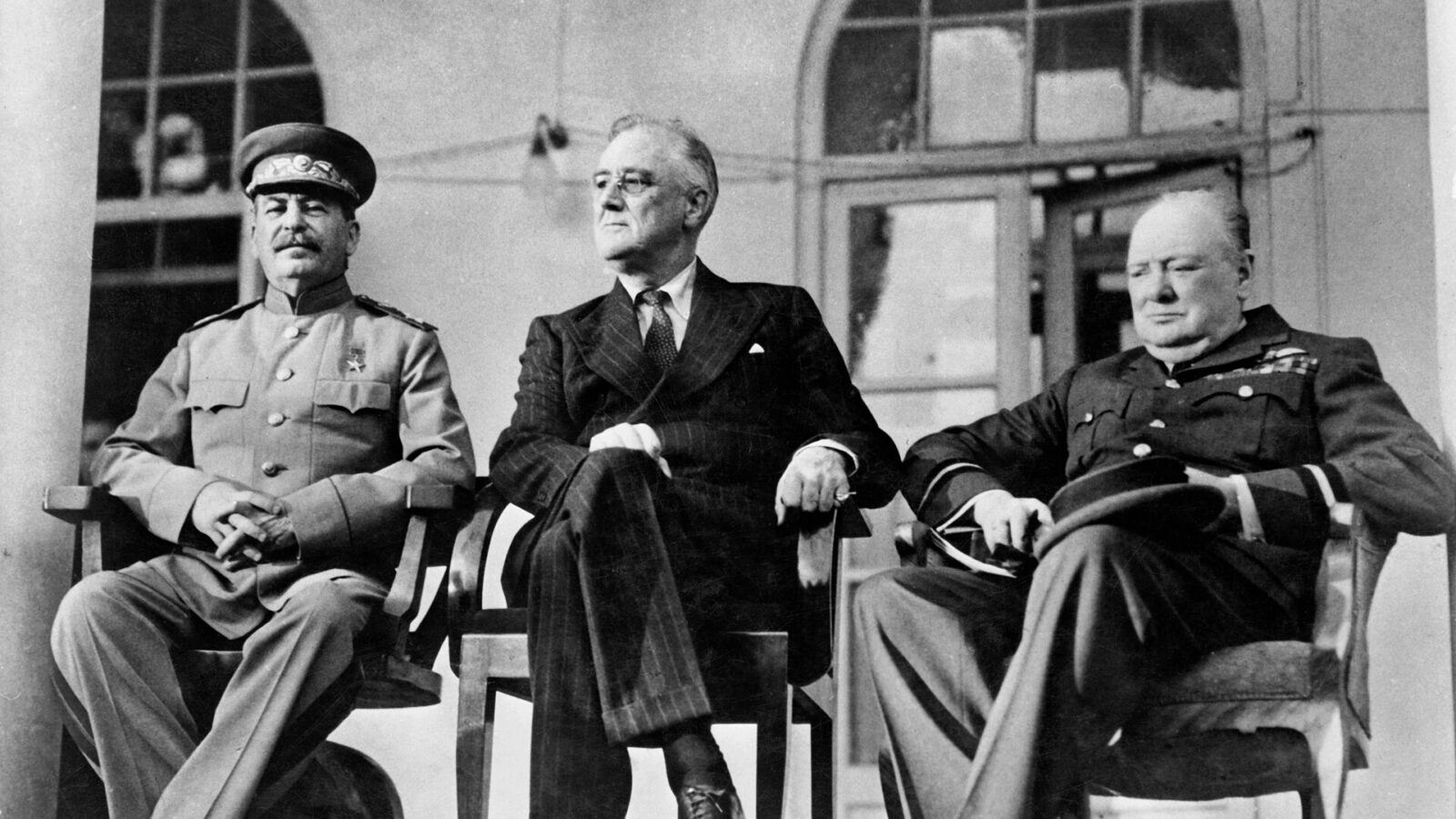
The Normandy landings were agreed more than six months before a single soldier stepped ashore — and the agreement was made nowhere near France. On 28 November 1943, in Tehran, the capital of Iran, US President Franklin D. Roosevelt, British Prime Minister Winston Churchill and Soviet leader Joseph Stalin met together for the first time. The venue was the Soviet Embassy, and the first full session opened at four in the afternoon. (U.S. Department of State, FRUS: The Conferences at Cairo and Tehran, 1943)
Watch the English video on Facebook: https://www.facebook.com/reel/1450062483980266
Watch the English video on YouTube: https://youtube.com/shorts/V2K5v7w8vRc
What happened?
The conference ran for four days, from 28 November to 1 December 1943. Its central outcome was military: Britain and the United States committed to opening a second front in Western Europe by invading northern France. The plan was codenamed Operation Overlord, and the target date was May 1944. In return, Stalin promised that the Soviet Union would launch a major offensive in the east at the same time, so Germany could not shift its forces west. (Imperial War Museums)
Background
Stalin had been demanding a second front since 1941. The Soviet Union was carrying the heaviest burden of the war in the east, while the Western Allies had advanced through North Africa and Italy. Churchill favoured the Mediterranean route, but the Americans — backed firmly by Stalin at Tehran — insisted on the direct cross-Channel attack. Tehran itself was chosen because Stalin refused to travel far from Soviet territory; Iran was at the time under Allied occupation.
The conference’s best-known side moment came on 29 November, when Churchill presented Stalin with a ceremonial sword — the Sword of Stalingrad, a gift from King George VI to the defenders of that city.
What happened next?
The May timetable slipped slightly, but the plan held. The Normandy landings began on 6 June 1944 — D-Day. In the east, the Soviet Union launched its enormous summer offensive, Operation Bagration, later that June, destroying Germany’s Army Group Centre. Germany was now fighting on two fronts, exactly as agreed in Tehran. (U.S. National Archives)
Why it still matters
Tehran was the first of three summits at which the Big Three sketched the map of post-war Europe — Yalta and Potsdam followed in 1945. The cooperation agreed in Tehran shortened the war against Germany, but the conference also opened the first serious talks on Poland’s borders and Germany’s future. Historians see it both as the high point of Allied unity and as the place where the dividing lines of the Cold War first began to show.
On the same day
On 28 November 1520, Ferdinand Magellan’s expedition sailed out of the strait that now bears his name and entered the Pacific — the first Europeans to reach that ocean, which Magellan named for its calm waters.
Sources
- U.S. Department of State — FRUS: The Conferences at Cairo and Tehran, 1943 (history.state.gov)
- Imperial War Museums — The Big Three and the Tehran Conference (iwm.org.uk)
- U.S. National Archives — D-Day, June 6, 1944 (archives.gov)
Photo: U.S. Signal Corps / Wikimedia Commons (public domain). Caption: Stalin, Roosevelt and Churchill on the portico of the Soviet Embassy in Tehran during the conference.
Photos: U.S. Signal Corps, U.S. Coast Guard, Imperial War Museums, U.S. National Archives, FDR Library, Library of Congress / Wikimedia Commons (all public domain).
Read also

Svinhufvud’s Senate Took Office on 27 November 1917 – Nine Days Before Independence
16 hours ago

Report an error · Discuss on Facebook @arkisuomi
Publisher: Arki Suomi · About us and the newsroom · Contact